Nine months have passed since the last AROS summary was published. Does that mean nothing has been happening in the AROS world during that time? Quite the opposite — so much has been going on that there simply wasn’t enough time to prepare regular updates :) Hopefully, from now on, these summaries will appear much more frequently.
Current state of the system and distributions
The current development base is ABIv11 20250418-1 together with Update 3 released in February 2026. This third update introduced a huge number of improvements, including bug fixes, driver updates, and many enhancements to the system’s stability and functionality. The list of changes is truly impressive, so anyone interested should definitely check the official release notes.
Based on the latest system version, AROS One 1.3 has also been released. At the moment, it is the most complete and polished AROS distribution available. It includes a large collection of software and comes preconfigured in a user-friendly way. If you are taking your first steps with AROS, AROS One is definitely the best place to start.
AROS One 1.3 is available in several formats:
- DVD ISO image: https://drive.google.com/file/d/1JytESCUh-h1wWahZCJmuzmAQ4IgLHFwK/view?usp=sharing
- IMG image for creating a bootable USB drive with tools such as Rufus: https://drive.google.com/file/d/1sWOJT7nvFheNUAIr0xhtsK9FroieMGSY/view?usp=sharing
- AROS Portable edition: https://arosnews.github.io/aros-portable
AROS Portable allows you to run the system directly from a USB stick using virtualization. Thanks to this approach, AROS can be launched on virtually any modern PC, even on hardware that is not natively supported by the system.
The second distribution based on the latest AROS release is AROS.games, which I have recently released myself. Its main characteristics are:
- minimalism — it does not try to include everything
- a retro visual style inspired more closely by the classic Amiga
- focus on retro gaming, emulators, and games
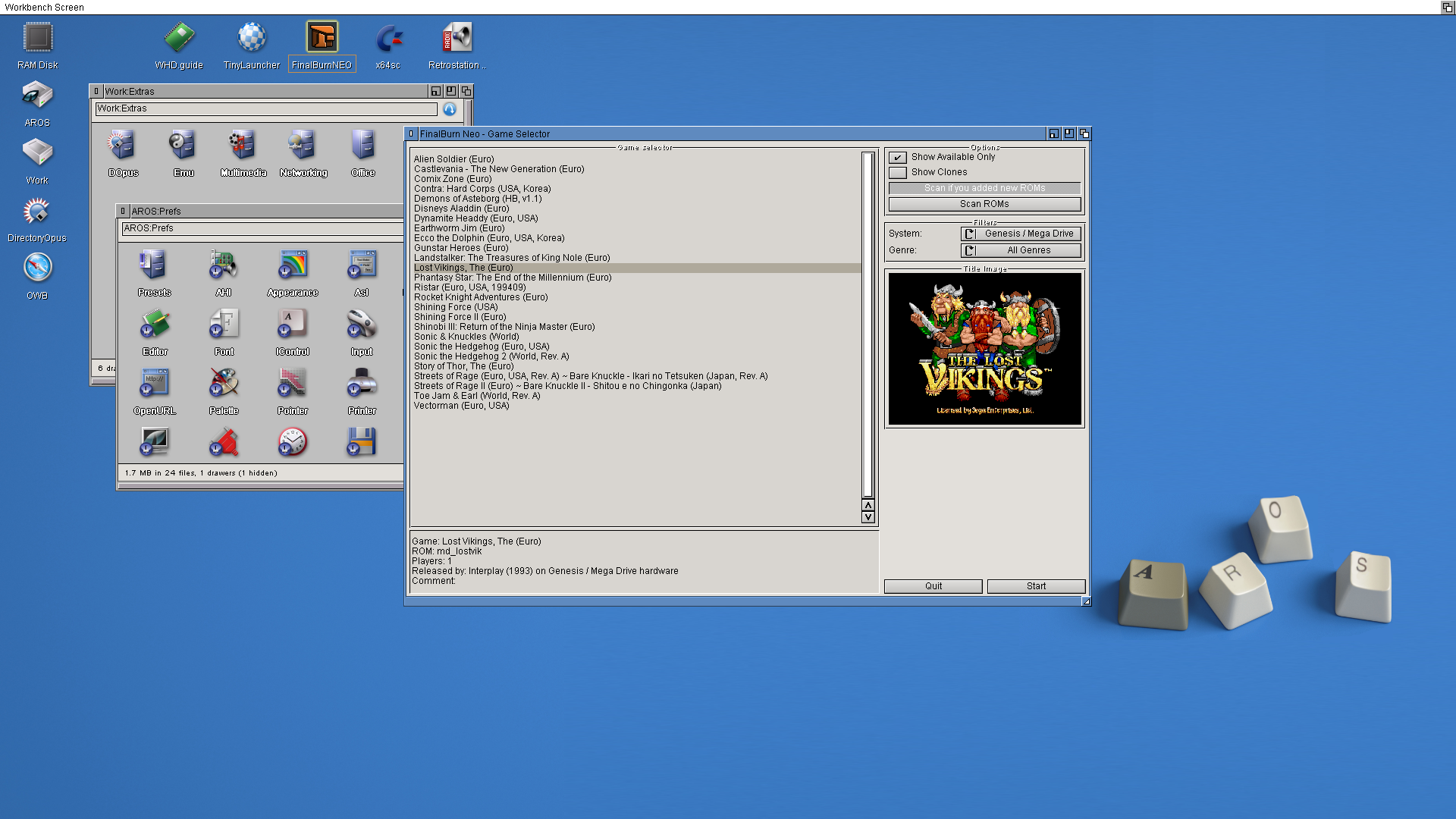 AROS.games
At the moment, AROS.games is available only as AROS Portable, but in the future an ISO image for native installation will also be prepared. The distribution can be downloaded from: https://aros.games
Transition to 64-bit
The long-awaited transition to 64-bit architecture has finally become reality. The distributions mentioned above are already based on the 64-bit version of the system — ABIv11. Most important and widely used software has already been ported to the new architecture.
One remaining issue is the lack of a native 64-bit version of Hollywood. Fortunately, Deadwood solved this problem by releasing EMUv0, an emulator that allows 32-bit applications to run on the 64-bit system. Tests show that most Hollywood applications work correctly this way.
Software
This time there will be no traditional review of AROS Archives releases — too much new software has appeared over the last nine months to cover everything. However, several projects deserve special mention.
The emulator scene has grown significantly. In addition to the already mentioned EMUv0, users now have access to:
- RetroArch
- FBNeo
- VICE
- DOSBox
- ScummVM
For many users, however, the most important addition is undoubtedly Amiberry, which allows classic Amiga software to run on 64-bit AROS much better than the older JanusUAE solution available on previous system versions.
Other noteworthy releases include a new version of the VIM editor and one of the biggest recent highlights — Directory Opus 5.
System development
A quick look at the activity in the main AROS Development Team GitHub repository clearly shows that development has not slowed down — in fact, it seems to be accelerating. Even better, new developers are joining the project while some former contributors have returned to active development.
Users interested in testing experimental features can already find builds with USB3 support and test drivers for newer Nvidia graphics cards on the AROS World forum.
Supporting the developers
AROS has always been a free, community-driven operating system. However, if you would like to support the developers and appreciate their work, you can do so via donations:
Kalamatee
PayPal: kalamatee@gmail.com
Ko-Fi: https://ko-fi.com/kalamatee
Deadwood
https://www.paypal.com/paypalme/4deadwood
AI-assisted software development
Artificial intelligence continues to spark discussion, but it is becoming increasingly clear that AI can be an excellent tool for developing and porting software for AROS.
Deadwood has prepared special starter packs that make it much easier to begin experimenting with AI-assisted programming for AROS. Detailed information can be found in the dedicated forum thread.
Personally, I have also been using OpenCode extensively lately, and I can confirm that it is an incredibly useful tool that dramatically speeds up development work. Interestingly, advanced programming knowledge is no longer even required to start creating simple applications — something clearly demonstrated by many recent videos and community projects.
Hopefully, starting next month, regular summaries will return once again. Until then, download the latest system versions, test new software, and put AI to work creating new productions for AROS :)